Vacuum Brazing and Diffusion Bonding of Laser Powder Bed Fusion Additively Manufactured Stainless Steel and Nickel Alloy
TWI Industrial Member Report 1225-2026
By Kandarp Amin, MSc, MEng, CMgr, Vaishali Prabhu, Mtech, MSc, BSc and James Redman, MEng (Hons), MWeldI
Industrial Need
Additive manufacturing (AM) in recent years has become an exciting technology to produce parts that are impossible to be made through traditional manufacturing routes. Advantages of this manufacturing method include increased efficiency, the ability to produce single parts rather than multiple parts, reduced material waste, ability to produce complex parts, easy prototyping and reduction in time to migrate products from design to the final production stage. These advantages play an important role especially in the sectors including Oil and Gas, Medical, Nuclear, Aerospace, Defence and Energy.
However, with the potential benefits of AM technology there are challenges that need to be addressed e.g. the production or prototyping of AM parts is limited to the volume of the build chamber.
Additive manufacturing can reduce the need for post-processing technologies such as joining by reducing the number of joints; however, a joint-free concept is unrealistic in most cases and therefore the product performance of hybrid structures, such as dissimilar metal joint products, is an important consideration. In short, the ability to join AM parts to other AM parts, or to the wrought/cast products, can result in the wider application of AM products. For instance, joining technologies can be used to join multiple AM part segments to make a larger assembly. Another benefit of joining smaller components to form a larger complete assembly is the reduction of potential scrap, if there was a defect within a smaller component, this could easily be replaced and hence making the manufacture of a large AM component less risky.
The joining of simple geometry AM parts could be achieved using traditional cost-effective manufacturing/joining techniques such as arc welding processes.
However, AM provides the ability to create parts that are complex in geometry and is able to create intricate internal features, which is one of the major benefits of this manufacturing method.
Parts containing internal features may require joining to other AM or wrought components. To join such parts and connect the internal features across different components is difficult or even impossible with many joining methods, as many joining methods depend upon line of sight when forming joints/welds, which is not possible if there are internal channels and features. This can be overcome by using joining techniques such as diffusion bonding and brazing, which are both capable of joining materials and features which are not line of sight.
The project motivation was to bridge the gap, develop the knowledge and address the effect of the joining methods used, in particular uniaxial diffusion bonding and vacuum brazing, on the microstructure and mechanical properties of the L-PBF joined structures made with 316L stainless steel (UNS S31603) and Alloy 718 (UNS N07718). These materials were selected based on feedback and the interests of Industrial Members of TWI within the aerospace and oil and gas industry.
Key Findings
- Joining trials demonstrated that brazing and diffusion bonding can be employed as methods for joining AM 316L and AM Alloy 718
- Trials successfully created AM-AM and AM-WR joints
- The joining of 316L with brazing found that the AM-AM joint achieved higher UTS
- Diffusion bonding of 316L found that the joints achieved near AM parent strength for both AM-AM and AM-WR joint configurations
- Brazing of Alloy 718 established a suitable process to incorporate solution treatment and aging around the brazing process to maintain optimum parent microstructure
- Diffusion bonding of Alloy 718 showed promise as cross-sections showed minimal/no defects at the AM-AM and AM-WR interface. However, further work is required to characterise the mechanical performance of joints
- Both brazing and diffusion bonding successfully demonstrated the ability to scale up to join larger AM 316L components with internal features, with demonstrators produced using both processes.
Impact
The completion of this project has successfully demonstrated that AM 316L and AM Alloy 718, made using laser powder bed fusion (L-PBF), can be joined to itself in AM form and also wrought form. This was achieved using vacuum brazing and diffusion bonding.
The project has characterised the AM-AM, AM-WR and WR-WR joint performance using mechanical testing and metallurgical assessment. The outputs from this characterisation will inform design engineers of the joint performance that could be expected when considering joining AM 316L or AM Alloy 718 into other AM or wrought assemblies.
The project has listed out the joining parameters used throughout the trials, including the brief parametric study for diffusion bonding processing parameters.
This information provides readers a strong starting point for implementing it into their production line or pursuing their own development trials. The joining parameters when scaled up, appeared to be able to join larger AM 316L components to form a larger AM assembly.
Finally, the bonding of the demonstrator, using diffusion bonding and vacuum brazing, showed that assemblies containing internal features were successfully joined without any visible change to the channels or distortion. This demonstrates the ability to re-think current component designs to assess if performance could be enhanced by joining an AM component features and/or internal channels that are not feasible with traditional machining routes.
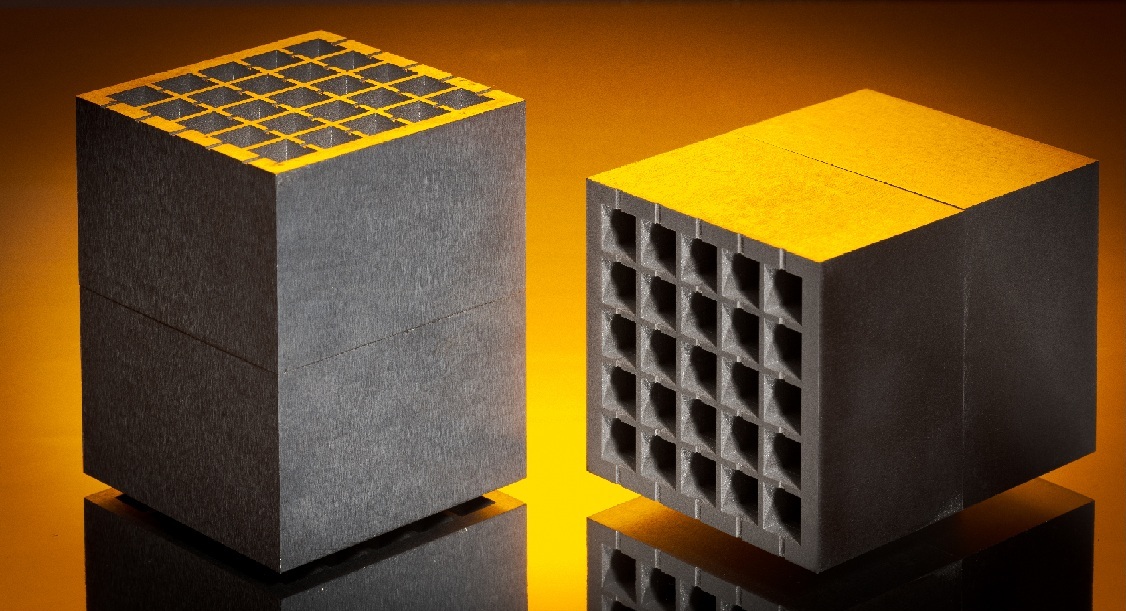
Figure 1: Two joined L-PBF 316L stainless steel demonstrators; (L) vacuum brazed & (R) diffusion bonded