Ultrasonic Sizing of Cracks Using Neural Network Models
TWI Industrial Member Report 1219-2026
By Channa Nageswaran EngD CEng FIMechE
Industrial Need
Cracking of industrial components and structures poses a significant threat to their integrity. Cracks emerging from the surface of engineering components can be detected using ultrasonic inspection techniques. In addition to detecting the cracks, there is a need to measure their growth into the component - termed the through-wall extent (TWE). Ultrasonic testing (UT) techniques are well-suited to interrogate the volume of metallic materials used in industry but achieving sufficient sensitivity to the tip of very sharp cracks is difficult. Without an accurate knowledge of where the tip of the crack lies in high resolution ultrasonic images there can be significant uncertainty in measuring the TWE of the cracking. This report demonstrates a system using neural network models to automatically size surface-breaking cracks. Neural network models are at the core of modern artificial intelligence (AI) technology within a field termed machine learning (ML), where the models are created by a process termed ‘training’ using, in the case of this report, examples of cracks with known TWE. Once trained they can be used to predict the size of cracks in new data and so can be used as part of UT systems.
This report presents neural network models and their performance in measuring the TWE of cracks in specimens. The models were created using experimental data and simulation results. In industry there can be insufficient data from real cracks to create the models because cracks tend to be rare and, even when found, the data is typically not available for various reasons. Therefore, a hybrid approach was investigated to develop the models using simulated results and a relatively small dataset from specimens containing representative cracking. The innovation introduced in this report is the feature engineering concept using the so-called snooker algorithm. The combined performance of two types of neural network models using the so-called snooker images was found to be sufficient.
Key Findings
- Neural network models can be developed successfully to perform through-wall extent sizing of surface-breaking fatigue cracks. This was made possible by feature engineering through a new imaging technique termed snooker developed for this purpose. The snooker algorithm leads to an image that is ideal for input to neural network models.
- Data for training, validation and testing is a key requirement for building neural network models. Good quality data can be difficult to obtain depending on the application scenario.
- Many factors can affect the predictions of models during inspection and therefore a statistical approach (eg averaging of multiple test results) to processing their output is necessary and this report shows that this led to a sizing accuracy within 1mm. The use of many models with individual observed characteristics may provide confidence in processing predictions in more complex inspection scenarios.
- Simulation results can be used to complement experimental datasets and can achieve similar testing performance to those built using experiments alone. This hybrid approach could help to alleviate the data availability issue in the inspection industry and potentially lead to more general models that could be adaptable to a broader range of inspection scenarios.
Impact
This report demonstrated the use of neural network models for sizing fatigue cracks using ultrasonic testing data. The analysis of the nature of the technology and its performance led to this report making important recommendations for industry to use this technology safely and effectively. The approach shown in this report can be replicated for several other inspection applications for which there is demand in industry, namely assessment of intermediate stage welding, detection and sizing of stress corrosion cracking, detection of early-stage high temperature hydrogen attack and austenitic weld inspection.
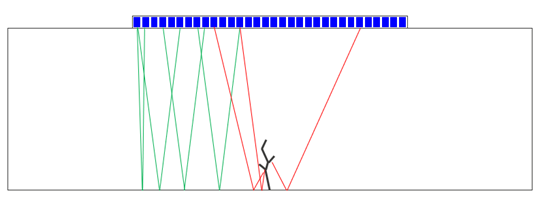
Figure 1: Snooker algorithm
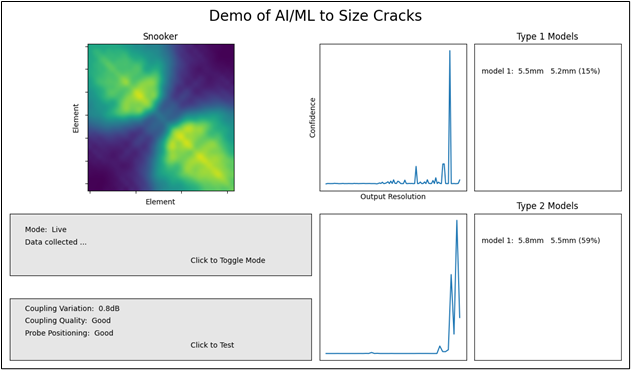
Figure 2: User interface to AI/ML model to measure crack size