Small-Scale Replication of Annular Environments Developed in RTP
TWI Industrial Member Report 1220-2026
By Amir Shamsa and Bernadette Craster CEng, FIMMM
Industrial Need
Thermoplastic composite pipes consist of a polymeric liner, reinforcement layer and polymeric cover. There is considered to be an annulus between the reinforcement layer and the cover. The reinforcement layer can be reinforced with steel cords, enabling extremely high-pressure applications such as carbon capture and storage (CCS). However, the static chemical environment which develops locally on the reinforcement wire is unknown and requires further research and study.
This project seeks to develop a system capable of (i) determining the species which permeate and their flux, to develop an understanding of the environments which may develop at an annulus and (ii) determine their influence on the corrosion behaviour of steel reinforcement cords.
This project builds on the capabilities of TWI’s recently designed and built 3-chamber permeation vessel by incorporating in-situ corrosion testing. This experiment could potentially be used outside of the scope of CCS to investigate other polymer/metallic interfaces. This may include more traditional oil and gas related environments/products such as flexible risers and enhanced oil recovery injection applications. The environment in the annulus could be determined without the need for large scale pipe tests. The research will provide the following:
- Corrosion performance data of coated (zinc coated) and non-coated carbon steel reinforcement cords.
- New and improved capability for polymer and metallic interface studies.
- Permeation and polymer performance data for each simulated CCS environment, i.e. permeation data for an impurity at a given concentration and pressure and temperature condition.
- Development work demonstrating the optimum method for the study of corrosion processes at polymer metallic interfaces.
Key Findings
- The highest volume flow rate measured for CO2 through the raised temperature polyethylene (PE-RT) was during the 200 bar and 80°C step (supercritical CO2) and was 4.8 times the measured flow rate for the polyphenylene sulfide (PPS) liner material.
- H2S was only measured as a permeant through the PE-RT liner material during a 6 hour accumulated period.
- The transport of water vapour was detected through PE-RT and PPS in the presence of the CO2 flow rate.
- Low concentrations of transported CO2, water vapour and H2S, were measured across the reinforcement layer (Armofor® tape material).
Impact
The impact of the project can be summarised as follows.
- The 3-chamber permeation cell was further developed to incorporate a location for exposure of uncoated steel specimens in the developed annulus.
- The optimum corrosion testing methods/design options for reinforcement cords were explored and developed.
- Established an improved understanding of the environments that may develop locally at steel wire surfaces within thermoplastic composite pipes.
- Further improved understanding of metallic/non-metallic interfaces that developed in high pressure CO2 environments using permeation and corrosion studies.
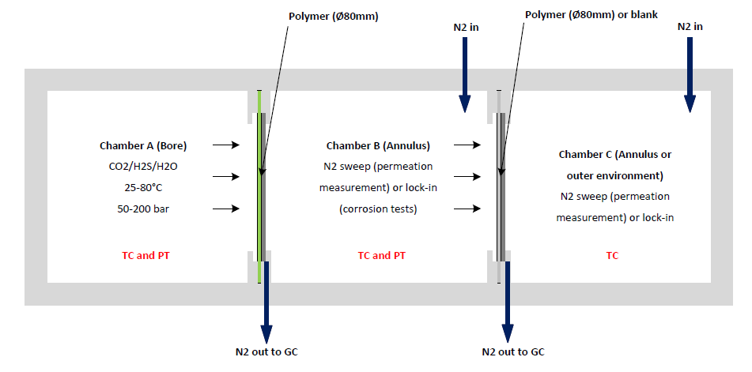
Figure 1: Schematic representation of the 3-chamber permeation cell