Development of Flaw Acceptance Criteria for Butt Fusion Welds in Polyethylene Pipes
TWI Industrial Member Report 1221-2026
By Maciej Gierulski, MEng, PhD
Industrial Need
Multiple industries are considering replacing their metallic components with polymer alternatives for plentiful reasons, including corrosion issues, biocompatibility and more applicable mechanical properties. A lack of systematic knowledge about flaw tolerance is a significant factor limiting the growth of popularity of welded plastic components. This project contributes to the development of the plastics industries, possibly leading to the acceptance of plastics in new applications.
Most of newly installed pipelines for water, sewage or gas distribution in the UK are made from polyethylene. This entails creating tens of thousands of pipe joints every year, which are critical for the safety of the pipelines. Around 20% of treated water running through pipes currently is lost due to leaks, which leads to increased costs of maintaining the system, risk of water shortage or breaks in service for some locations. Potential gas or sewage leaks can be dangerous to human safety and harmful to the environment. There is institutional pressure to reduce the volume of leaks and joint safety is absolutely a key factor in this task. Better understanding of the influence of flaws on joint integrity would allow for more accurate filtering of joints and reducing the risk of leakage.
Key Findings
- The planar flaw acceptance criterion for butt fusion welds in 225mm diameter PE pipes, based on short-term performance, was found to be 2.8mm diameter.
- Positions for placing aluminium discs in a PE pipe butt fusion weld were found to ensure that they stay within the thickness of the pipe after the welding process. It was also discovered that the disc movement happens predominantly when the two pipes are brought together after being melted against the heater plate.
- It was found that up to 30 minutes between trimming the pipe ends and making the weld did not significantly influence the mechanical properties of the weld.
- Elongation and energy to break per unit area are linearly dependent on flaw size for ⌀315mm pipe for the particular specimen geometry, whereas for ⌀225mm pipe and different specimen geometry the relation was exponential.
- A set of parameters that allow for precisely measuring the position of 25μm thick aluminium foil discs within a PE ring using X-ray radiography was established.
Impact
This project provides a systematic way of determining flaw acceptance criteria for butt fusion welds in plastics pipes based on short-term performance which, when combined with volumetric NDT, provides a route to assessing the integrity of plastic welds, which is already available for metallic welds.
Flaw acceptance criteria have been determined, based on energy to break. Equations that allow for calculating the strength and energy to break for a range of flaw sizes have been established. In addition, it was discovered that the energy to break and strength values follow characteristic patterns for each pipe size and new gaps in knowledge were identified, which, when followed, should lead to better understanding of butt fusion weld behaviour and being able to predict failure.
Through a number of iterations of welding and measuring the displacement of flaws, positions for placing aluminium discs in a weld were established, allowing TWI to reliably produce specimens with artificially inserted flaws.
A set of parameters was successfully established that allow for aluminium discs to be detected in X-ray radiographs.
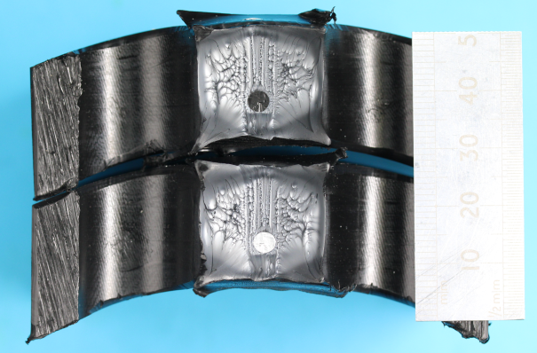
Figure 1: Fracture surface of a specimen cut from a ⌀225mm pipe, containing a ⌀4mm flaw.
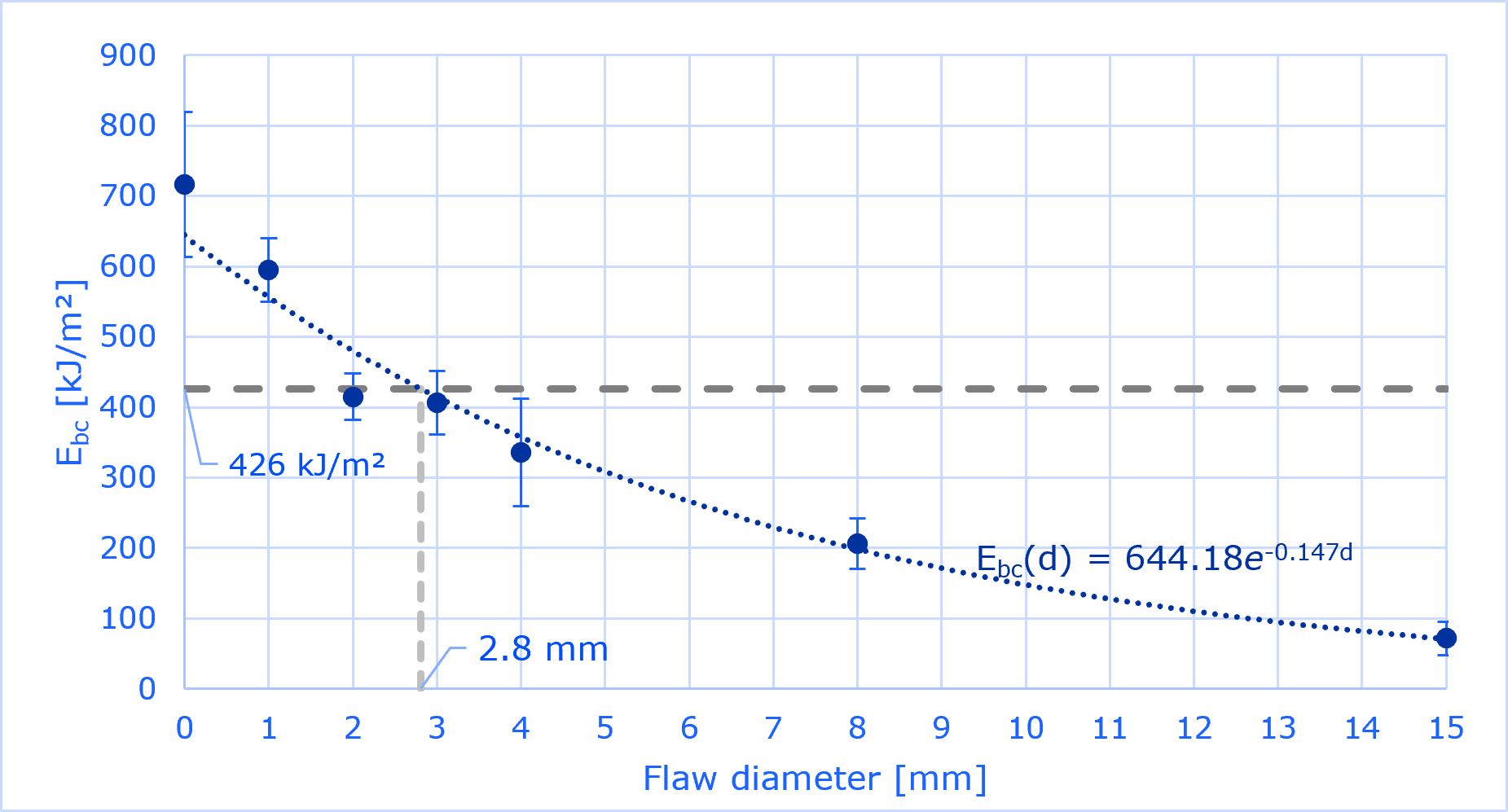
Figure 2: Graph showing energy to break/area vs. flaw diameter for ⌀225mm pipe welds with lines marking the critical energy to break value and the corresponding flaw diameter