Mon, 03 August, 2026
We are delighted to announce the launch of a new project, 'Joining of Additive Manufacturing Components (JAM),’ which is funded by European Space Agency (ESA) and UK Space Agency (UKSA) and is part of the General Support Technology Programme (GSTP).
This 24-month project, which is being led by TWI Technology Consultant and Project Manager Dr Raja Khan, is being undertaken in partnership with ArianeGroup, APWorks and Airbus Defence and Space to provide a new route for the manufacture of large-scale, complex space structures.
The Challenge
The manufacture of large space structures relies heavily on traditional methods such as castings and forgings. However, while the techniques deliver strong and reliable components, they are expensive, have long lead times, and create high buy-to-fly ratios with much of the original material being wasted during extensive machining operations.
In an industry where material optimisation and weight reduction are critical, additive manufacturing processes, such as the laser powder bed fusion (L-PBF) technique, offer an alternative for creating topologically optimised complex geometrical components. However, the majority of commercially available L-PBF systems have part size limitations whereas large L-PBF systems are costly, have limited availability and face challenges in scaling up, such as managing residual stresses and ensuring consistent quality across large parts.
In addition, constraints on L-PBF chamber sizes in relation to build volumes and the complexity of maintaining powder quality further limit their effectiveness, leading to higher production costs and increased risk of part failure.
The challenge being addressed by this new project is to find a way to combine additive manufacturing (AM) via L-PBF with modular construction to provide scalability and cost-effectiveness.
The Solution
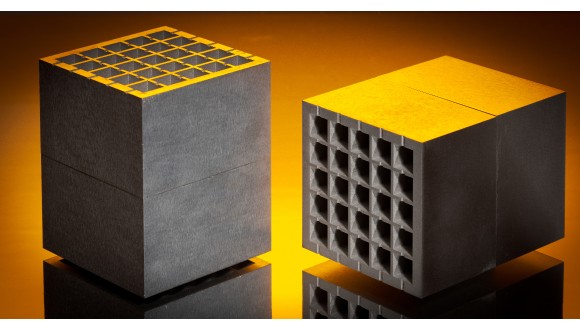
TWI’s proposed solution involves creating smaller aluminium alloy AM parts that are then joined together to create larger structures, opening up the possibility of creating intricate, customised assemblies that would be challenging to produce as single pieces, while being able to integrate high-performance AM parts with standard components and different materials. This method improves machine utilisation, simplifies repair and maintenance, and reduces overall weight.
AM is already widely adopted by the space sector, with companies such as Airbus, ArianeGroup, Lockheed Martin, and others using it to produce over 50,000 parts annually, therefore this new manufacturing methodology will help in further growing the use of AM space structural components.
TWI will explore three joining processes to bond various part segments made from AlSi10Mg and Scalmalloy aluminium materials with the aim to apply the learnings to other materials as well which are relevant to the space structures and propulsion systems, as follows:
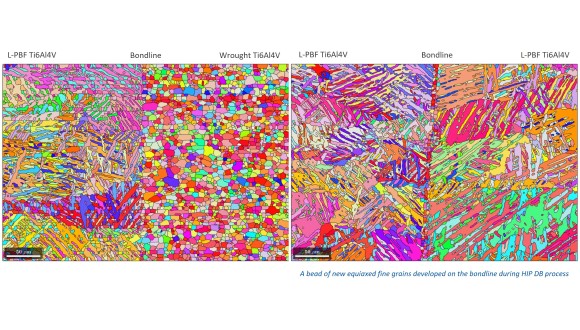
Hot Isostatic Pressing Diffusion Bonding (HIP DB): A solid-state joining process where joints are formed under the application of pressure and high temperature over a given hold time. The process relies upon atomic diffusion across the joint interface(s) which results in a joint with parent material properties. HIP DB is ideal for creating high strength, defect-free joints in AM space components for critical space structures from propulsion systems to structural frames, shielding barriers and supports dissimilar material bonding for hybrid designs where structural integrity is essential.
Linear Friction Welding (LFW): Offers a method to join AM parts to larger structures. Another solid-state process, LFW also avoids many of the defects associated with melting and solidification. Recent studies have demonstrated that LFW is a viable process to weld AM components and can reduce the internal defects.
Vacuum Brazing: Uses a molten filler metal to join AM parts with the ability to create strong joints, even between dissimilar materials. Brazing is particularly useful for joining intricate or thin-walled AM components where welding might be impractical. It offers the flexibility to join various metals and alloys, providing robust joints that maintain high strength and integrity across different operational conditions. Already used by the space sector, this process is well-suited to the joining of complex, multi-part assemblies.
Additionally, the geometrical freedom of AM enables new design approaches for tailored interfaces between components and for the integration of the joint in a larger assembly, optimised for the joining processes used, the overall geometries, and the material combinations.
Example Applications
Space sector applications that can benefit from joining smaller AM components include AM produced RF components, support structures for satellite components (such as solar arrays, antennas, and payloads), large panels or frames that form the primary structure of spacecraft, rockets, space habitats, and modules. In addition, AM produced flanges, ports, and fittings can also be joined to larger tanks and pressure vessels used for storing propellants and other fluids.