Tue, 10 February, 2026
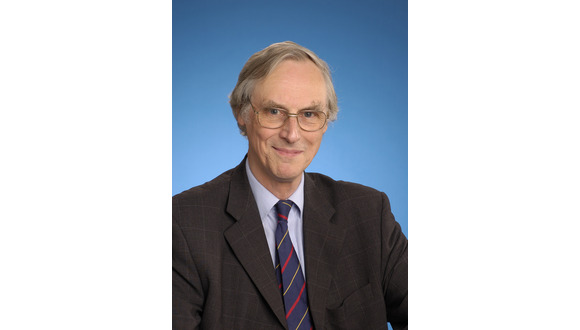
Dr Martin Ogle, who died on 26 October 2025, aged 88, was a remarkable engineer specialising in the design and integrity of bridges and other major structures. He served as Head of Structures and Principal Design Consultant at TWI from 1978 until his retirement in 2010. After completing a PhD in engineering at Cambridge University, he joined G Maunsell and Partners in 1962, becoming an associate and specialising in bridge design and construction. Martin played a prominent role in the development of British and international standards for steel and aluminium structures, with a particular focus on weld quality, and his work had a lasting impact on the safety of bridges and other structures. Even after retiring, he remained an external consultant to TWI and continued to contribute to standards development up to the end.
Martin Hugh Ogle was born in Norwich on 16 September 1937 and spent his early years in London. Following school at Bryanston in Dorset, where he demonstrated that he was not only academically gifted, but also excelled in sprinting, gymnastics and boxing, he studied engineering at Imperial College London, graduating with First Class Honours. He subsequently gained a PhD in structural engineering from Cambridge University on “Research into Shakedown of Steel Frames” in 1962. He then joined civil engineers G Maunsell and Partners in their bridge design office.
In 1964 he married Evelyn (Brindi) Raemaekers. Shortly after their wedding, and still only in his 20s, Martin took up the role of Deputy Resident Engineer, on behalf of Maunsell, for construction of the Batman Bridge over the River Tamar in Tasmania. They lived in Australia for four years until completion of the project. The bridge was of an innovative design, being an asymmetric cable‑stayed structure with a single inclined A‑frame tower. This arrangement was dictated by ground conditions, as only the west bank of the river provided sufficiently firm foundations, the east bank consisting of soft clay. This resulted in an elegant as well as efficient structure.
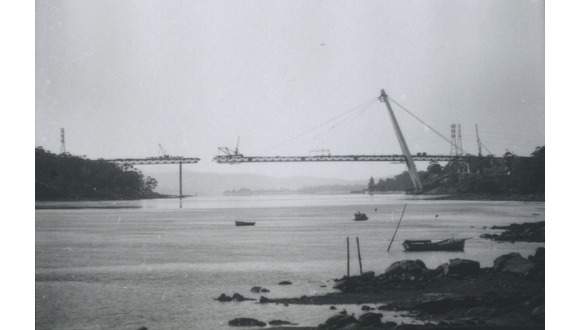 Photograph of the Batman Bridge, taken on-site by Martin Ogle
Martin continued to work for Maunsell until 1978, when he joined TWI as a Principal Engineer. He later became Head of Structures and Principal Design Consultant. He was involved in a wide range of structural integrity investigations for industrial clients, but two projects in particular illustrate his ability to solve major industrial problems of national significance.
The first was for Transport for London and involved inspection, assessment and fatigue life improvement of escalator step shafts at numerous London Underground stations. This work lasted for over 5 years in total, from around 2003 to 2008. The work required an innovative solution involving semi-automated weld toe burr machining under restricted access. Much of the work had to be done at night when the network was not in use, thereby saving huge sums in compensation for unscheduled closures and avoiding significant passenger disruption. Martin spent many nights on-site coordinating the activities.
The second significant project relates to the Boston Manor viaduct in west London. This carries the M4 motorway, the main route out of the capital to the west, and is located between central London and Heathrow airport. There had been ongoing concerns over this structure. TWI had been involved in monitoring stresses in this structure from 2009 but, in 2012, significant defects were found in some of the welds, resulting in the closure of the motorway. The TWI team, led by Martin and involving fracture, fatigue, and NDT specialists, worked extensively to justify the re-opening of the viaduct. This included Martin, at the age of 75, climbing ladders up into the structure to assess certain details. The motorway was reopened just before the start of the 2012 London Olympic Games, thus avoiding major traffic disruption.
Another notable project was the ‘B of the Bang’ in 2006/2007. The ‘B of the Bang’ was a giant, spiky steel sculpture in Manchester, designed to commemorate the 2002 Commonwealth Games; the sculpture itself represented an exploding firework. The welded steel structure stood 184ft high and comprised 180 steel spikes radiating from its core. Due to structural concerns, the sculpture was dismantled following failure of one of the spikes, which fell to the ground. Martin was asked to investigate the failure of the structure, which was found to contain numerous weld defects.
In addition to his work on structures, Martin was also involved in evaluation of pressure equipment. One notable project was an investigation into cells for storing high pressure hydrogen for use in road vehicles, long before alternative fuels for road transport became widely studied.
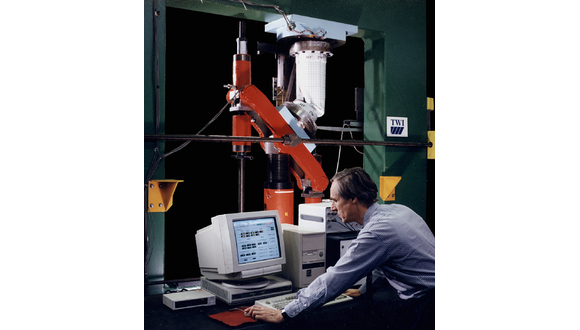
Alongside his industrial work, Martin was committed to sharing practical engineering insight with the next generation. He gave lectures at Imperial College on how to undertake ‘back‑of‑the‑envelope’ structural calculations, demonstrating how simple hand calculations can be used to form rapid, reliable assessments of structural integrity. These lectures were highly valued for their clarity, pragmatism and emphasis on sound engineering judgement.
He retired from TWI in 2010, but continued as an external consultant right up to his death. In 2019, TWI organised a seminar on ageing bridges, which Martin chaired. The event attracted 55 delegates and saw key speakers from the construction industry and TWI experts sharing information on matters including life extension, inspection, repair, and major refurbishment projects.
Martin approached all his work with meticulous attention to detail. This was especially evident in his standards work, where he had a significant influence over the development of requirements for both steel and aluminium structures, with particular reference to welding quality and its effect on structural integrity. Martin continued to be involved in standards committee work up to the week of his death. He was committed to excellence in engineering and ensuring that welded constructions would be safe. He will be sorely missed.
Martin is survived by his wife, Brindi, and their younger son, Simon. Tragically, their elder son, John, died in 2012.